A large-diameter UAV propeller can pass a bench inspection and still contact a nacelle, arm, or adjacent blade after rotor speed increases. This guide explains how to check large drone propeller blade flex, set up dynamic clearance measurement for UAV propellers, and build a large-diameter UAV propeller inspection checklist. The process combines visual inspection, controlled deflection testing, propeller pitch verification, rotor disk alignment, vibration analysis, and tip clearance measurement. Used correctly, these steps help operators identify fatigue, prevent interference, and document a repeatable maintenance decision before a flight.
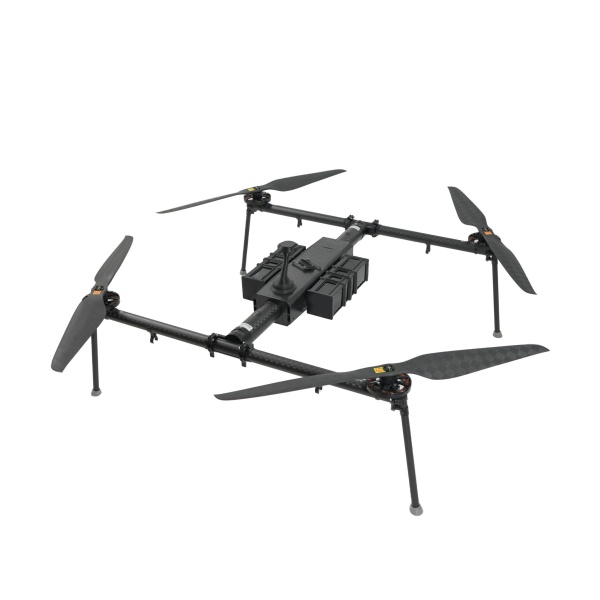
Blade condition and clearance should be checked together because flex can change the available gap during operation. Image source: Rayi.
Why Blade Flex and Dynamic Clearance Matter on Large Drone Propellers
A propeller blade is a rotating beam. Centrifugal force produces tension along the blade, while aerodynamic thrust and torque create bending loads. The blade can also experience vibration caused by mass imbalance, pitch mismatch, motor alignment error, bearing wear, or a damaged hub. As a result, the clearance measured with the aircraft stopped is not necessarily the smallest clearance during operation.
Dynamic clearance is the smallest distance between a moving blade and a fixed or rotating object throughout the operating range. Relevant objects include the motor mount, fuselage, landing gear, protective cage, wiring, battery enclosure, neighboring rotors, and the ground. A safe inspection therefore needs two separate answers:
How far does each blade move under controlled load?
How much clearance remains when the rotor is turning at the planned speed and load?
Do not apply a universal clearance number from another aircraft. Blade stiffness, diameter, material, hub geometry, motor speed, air density, and structural vibration all change the result. The aircraft or propeller manufacturer must define the allowable blade deflection, damage limits, tracking tolerance, and minimum clearance. If those limits are unavailable, the aircraft should not be released solely on an operator\'s estimate.
Large-Diameter UAV Propeller Inspection Checklist Before Testing
Prepare the aircraft and the measurement tools before touching the blade. A repeatable setup is more useful than a single impressive measurement.
Tools for a Large Drone Propeller Blade Flex Check
Manufacturer maintenance manual and approved propeller data.
Calibrated ruler, depth gauge, or laser distance meter for initial clearance.
Dial indicator with a stable magnetic or mechanical base for deflection and hub runout.
Feeler gauges for accessible static gaps.
Digital scale or approved force gauge for a controlled static load.
Non-permanent marker or numbered blade labels.
Torque wrench for hub fasteners, used at the specified torque.
High-speed camera or optical displacement sensor for authorized dynamic testing.
Vibration sensor or flight controller vibration log, where supported.
Personal protective equipment and a propeller restraint or test stand approved for the aircraft.
Record propeller part number, serial number, diameter, pitch, operating hours, flight cycles, and previous repairs.
Clean the blade with the material-approved method. Dirt can hide cracks and can also create a false imbalance.
Inspect the leading edge, trailing edge, tip, pressure side, suction side, root, hub bore, bolt holes, and bonding lines.
Look for cracks, whitening, delamination, swelling, impact marks, exposed fibers, loose inserts, and edge separation.
Check that the blade is seated fully in the hub and that washers, fasteners, spacers, and locking devices match the approved configuration.
Compare all blades for tracking, pitch position, mass balance, and visible twist. Do not sand or reshape a composite blade unless the manufacturer approves the repair.
Measure the aircraft with the landing gear compressed or loaded in the condition specified by the manufacturer. Structural sag can change clearance.
Tip 1: Measure Static Blade Flex on a Large Drone Propeller
Why: A controlled static deflection test reveals stiffness differences and permanent deformation before the rotor is operated.
How to Perform a Large Drone Propeller Blade Flex Test
Remove the propeller or secure the aircraft in an approved maintenance fixture. The motor must be electrically isolated, and the propeller must not be able to start.
Support the hub exactly as it is supported in service. A soft or uneven fixture can create a false reading.
Place the dial indicator at a documented radial station, such as a marked distance from the hub. Use the same station on every blade.
Zero the indicator with no external load. Record the blade position and ambient temperature.
Apply the manufacturer-specified force at the specified radius and direction. If no approved force and limit exist, do not invent a pass or fail threshold.
Record loaded deflection, release the force slowly, and record residual deflection after a defined wait period.
Repeat the test for every blade and compare both absolute values and blade-to-blade differences.
For documentation, write the result as a measurement rather than an adjective. For example, record "blade 1 deflection 2.4 mm at 30 N, residual deflection 0.2 mm after 60 seconds" instead of "blade 1 is flexible." The example is a reporting format, not a universal acceptance limit.
A blade that has a larger deflection than its matched blades, or that does not return close to its original position, requires a manufacturer review. Permanent set can indicate impact damage, heat damage, moisture-related composite degradation, a loose insert, or delamination. Do not try to correct the difference by bending the blade by hand.
Tip 2: Check Large-Diameter UAV Propeller Runout and Tracking
Why: Runout and tracking errors can reduce the apparent gap even when the blade itself has acceptable stiffness.
Runout Procedure for a Large-Diameter UAV Propeller
Install the propeller on the approved hub with the specified fastener torque and locking method.
Place a fixed pointer or dial indicator near the blade tip, but do not touch the blade during rotation.
Rotate the propeller slowly by hand through one complete revolution and record the maximum and minimum positions at the same radial station.
Repeat at a second station if the blade has significant twist or taper.
Compare the tracking path of all blades. A consistent offset across every blade may indicate hub or shaft alignment. One blade that differs may indicate blade or root damage.
Measure motor shaft or hub runout separately if the design allows it. Separate component readings prevent misdiagnosis.
Use the manufacturer\'s runout tolerance. If the manual specifies a total indicator reading, calculate it as the maximum indicator value minus the minimum indicator value. Do not confuse radial runout with axial runout, and do not treat a visual circle as proof of correct tracking.
Tip 3: Calculate Dynamic Clearance for Large Drone Propellers
Why: The smallest operating gap is more important than the largest parked gap when a blade approaches a fixed structure or another rotor.
Dynamic Clearance Measurement for UAV Propellers
First map the clearance envelope with the rotor stopped. Measure the gap at several blade azimuth positions, not only at the point that looks closest. Mark the blade tip, mid-span, and any suspected contact path. Then consider the movement caused by:
Blade bending from thrust and torque.
Blade flapping or coning under aerodynamic load.
Motor shaft and hub runout.
Airframe flex, landing gear compression, and payload movement.
Rotor vibration and control system oscillation.
Temperature-related changes in composite dimensions or mounting structure.
This expression is a planning model, not a substitute for a validated test. Each term must be measured or supplied by the aircraft manufacturer. If the result is close to zero, stop the test and obtain engineering approval. Any contact mark, sound, vibration increase, or sudden change in clearance is a failed test condition.
How to Perform an Authorized Dynamic Clearance Test
Use a test stand, tethered test area, or maintenance procedure specifically approved for the aircraft. Keep people outside the hazard zone.
Remove loose objects and confirm that the test area can contain a blade or component failure according to the operator\'s risk assessment.
Install non-contact optical targets or high-speed video markers if they do not change the mass balance or interfere with the rotor.
Start at the lowest approved speed and observe the rotor remotely. Never use a hand-held feeler gauge near a spinning propeller.
Increase speed only in the steps specified by the manufacturer. Record rotor speed, battery voltage, payload, air temperature, wind, vibration, and measured clearance.
Repeat the observation in the operating attitudes that can reduce clearance, including takeoff, hover, acceleration, braking, and maximum approved load where permitted.
Stop immediately for contact, visible blade instability, abnormal noise, rising vibration, control oscillation, or a clearance value below the approved limit.
For a multi-rotor aircraft, check adjacent rotor interaction as well as blade-to-frame clearance. Rotor disks can overlap in projection even when the parked tips appear separated. The test should identify the closest phase relationship between neighboring rotors across the planned speed range.
Tip 4: Use Vibration Analysis to Find Flex-Related Problems on Large Drone Propellers
Why: A flex problem may appear as a speed-dependent vibration pattern before a crack or contact mark becomes visible.
Large Drone Propeller Vibration Analysis Method
Record baseline vibration with a known-good propeller configuration, if available.
Log vibration at the same motor speed, payload, battery condition, and flight mode. Changing several variables at once makes the comparison weak.
Look for vibration that rises at a specific rotational speed, changes with blade loading, or appears only during acceleration or braking.
Inspect propeller balance, pitch, hub seating, shaft runout, motor bearings, and fastener torque before blaming blade flex.
Compare the affected motor with the other motors. A single-channel difference is useful evidence, but it is not proof of a particular failure.
After any adjustment, repeat the same test and save the new log with the date and component serial number.
Vibration frequency can help separate causes. A once-per-revolution signal can be associated with mass imbalance or alignment, while higher-order components may relate to blade passage or structural resonance. Interpretation depends on the sensor location, sampling rate, motor pole count, controller filtering, and aircraft design. Use the flight controller or vibration sensor manufacturer\'s guidance rather than relying on a generic frequency rule.
Tip 5: Inspect Large-Diameter UAV Propeller Material and Root Areas
Why: Damage near the root can reduce stiffness and change dynamic clearance even when the tip looks undamaged.
What to Check on Composite and Carbon Fiber Blades
Inspect for impact dents, resin cracks, fiber exposure, surface ripples, and changes in color or gloss.
Check the root for looseness, insert movement, bolt-hole elongation, fretting, and separation between bonded parts.
Look for delamination indicators such as a soft area, raised skin, local bulge, or a change in sound during an approved tap inspection.
Use ultrasonic, thermographic, or other nondestructive inspection only when the method and interpretation are approved for the material and structure.
Quarantine a blade after a strike or abnormal landing until a qualified person determines whether it is serviceable.
Do not assume that an apparently small nick is harmless. The effect depends on its depth, location, orientation, and the blade\'s load path. A root defect can produce more deflection than a larger cosmetic mark near the tip.
Which Large Drone Propeller Inspection Technique Fits Your Scenario?
Finds obvious damage and installation errors without running the rotor.
After a ground strike or hard landing
Root inspection, static flex comparison, runout, and manufacturer review
Impact can create hidden damage and permanent deformation.
New frame, motor, propeller, or payload installation
Full clearance map, tracking check, and controlled dynamic test
Mass, geometry, and structural movement may have changed.
Vibration appears at one speed
Vibration log, balance check, runout check, and speed sweep under approval
A speed-dependent response may indicate imbalance, resonance, or alignment error.
Composite blade shows a soft area or surface crack
Quarantine and qualified nondestructive inspection
Operating the blade may worsen hidden structural damage.
Two neighboring rotors appear close
Multi-rotor dynamic clearance assessment
Rotor phase, flapping, and frame flex can reduce the gap during flight.
Common Errors When Checking Large-Diameter UAV Propeller Flex
Using a universal gap value: Clearance limits must come from the aircraft or propeller design authority.
Testing only at rest: Static clearance cannot show all movement from deflection, runout, vibration, and airframe flex.
Applying an unknown force: A hand push is not a repeatable blade flex test. Use a calibrated load and documented radius.
Ignoring residual deflection: A blade that does not return to its original position may have permanent damage.
Changing pitch or sanding the tip: Material removal can alter balance, stiffness, aerodynamic performance, and fatigue life.
Running a test without containment: A spinning large propeller is a serious hazard. Remote operation and an approved test area are essential.
Recording only pass or fail: Save raw measurements, environmental conditions, component identification, and photographs so that trends can be detected.
Documentation Template for a Large-Diameter UAV Propeller Inspection
Use one record for each propeller and update it after every relevant event. Include:
Aircraft registration or fleet number.
Propeller manufacturer, model, diameter, pitch, serial number, and installation position.
Inspection date, operating hours, flight cycles, and technician identity.
Static clearance at each marked location.
Blade deflection, applied force, radial station, residual deflection, and temperature.
Hub and shaft runout, tracking observations, and fastener torque confirmation.
Dynamic test speed, payload, flight mode, minimum measured clearance, and vibration readings.
Photographs of damage, measurement setup, and any rejected component.
Reference to the exact manufacturer manual revision and acceptance limit.
Release decision, corrective action, and approval signature.
A measurement trend is often more informative than a single result. For example, a change from 1.1 mm to 1.8 mm of residual deflection across three inspections should trigger a review even if both values appear visually small. The correct decision depends on the approved limit and the design\'s safety margin.
Key Points for Large Drone Propeller Blade Flex and Clearance
Inspect the blade, hub, motor shaft, and surrounding structure as one system.
Measure static deflection with a known force and a fixed radial station.
Check runout and blade tracking separately from blade flex.
Calculate or measure the minimum dynamic clearance across the approved operating range.
Use vibration data to support diagnosis, not to replace a physical inspection.
Follow the manufacturer limit for deflection, runout, damage, and minimum clearance.
Quarantine any blade involved in contact, impact, cracking, delamination, or unexplained vibration until it is approved for service.
Authoritative References for UAV Propeller Inspection
FAA Advisory Circular AC 43.13-1B. This is a reference for acceptable methods, techniques, and practices when manufacturer instructions are not available and when its use is appropriate.
Rayi Aero. Consult the relevant Rayi propeller product documentation for model-specific installation and inspection limits.
These references do not replace the instructions for a particular aircraft. Manufacturer service bulletins, maintenance manuals, airworthiness notices, and approved repair data take priority whenever they provide a specific limit or procedure.
FAQ About Large-Diameter UAV Propeller Flex and Dynamic Clearance
How much blade flex is acceptable on a large drone propeller?
There is no reliable universal value. The allowable deflection depends on blade design, material, diameter, hub support, motor speed, and surrounding structure. Use the manufacturer\'s specified force, measurement location, and limit. If no limit is available, obtain engineering approval before flight.
Can I check dynamic clearance with a ruler while the propeller is spinning?
No. A hand-held ruler or feeler gauge near a rotating propeller creates an unnecessary injury and equipment hazard. Use a remote optical method, high-speed video, or a validated sensor setup within an approved test procedure.
Why does a blade have more clearance when stopped than during flight?
Thrust, torque, flapping, coning, motor shaft runout, vibration, and airframe flex can move the blade or the surrounding structure. The parked measurement captures only the unloaded geometry.
What should I do if one blade has more deflection than the others?
Stop normal operation and compare the test setup, force, blade position, and measurement station first. If the difference remains, quarantine the blade and inspect the root, inserts, bonding, and composite structure through an approved process.
Does balancing a propeller solve a clearance problem?
Not necessarily. Balancing can reduce vibration caused by mass distribution, but it does not repair a cracked blade, correct excessive shaft runout, restore stiffness, or fix an incorrectly positioned motor. Clearance and structural condition must be checked separately.
How often should large-diameter UAV propeller flex be checked?
Follow the aircraft maintenance program and the propeller manufacturer\'s interval. Perform an additional inspection after a strike, hard landing, abnormal vibration, overspeed event, transport damage, unexplained contact mark, or major motor, frame, or payload change.
Tips for Checking Blade Flex and Dynamic Clearance
Aug. 10, 2026
Cookie Policy
We use cookies on this site, including third party cookies, in order for the site to work properly and to
analyse traffic, offer enhanced functionality, social media features, and personalise content and ads.