

Want to Choose the Right Products for You?
Take a quick test to find the right propeller for you.












The T-Motor AIR GEAR 450 II Combo is a compact multirotor propulsion system designed for DIY drone builds and small multirotor platforms. The system combines AIR2216II KV920 motors, AIR 20A electronic speed controllers and T1045 propellers to provide a matched propulsion configuration for streamlined integration. The motor specification supports 4S LiPo operation with a rated voltage of 16V, while the AIR 20A ESC supports 3–4S input and a 50Hz–600Hz throttle signal frequency. The included T1045 propeller specification is 10 × 4.5 inches and uses a nylon and glass-fiber material blend. Please confirm the aircraft frame, battery, motor direction, ESC connection and propeller clearance before installation.
Multirotor Propulsion System
AIR2216II KV920 Motor · AIR 20A ESC · T1045 Propeller
Integrated Propulsion Kit for Multirotor Builds
A Matched System for DIY Multirotor Builds
The AIR GEAR 450 II Combo brings the main propulsion components together in one coordinated package. AIR2216II KV920 motors, AIR 20A ESCs and T1045 propellers are selected as a combined system for compact multirotor platforms. This helps reduce component-matching work during the initial integration stage while keeping the motor, ESC and propeller specifications clearly identifiable for builders and system integrators.
Clear Component Matching for Configuration Planning
The supplied recommendation information identifies the AIR2216II KV920 motor, T1045 propeller, AIR 20A ESC and 4S battery configuration. The reference setup is intended to help users evaluate multirotor propulsion compatibility before assembly. Frame size, aircraft take-off weight, battery condition, flight mode and coaxial configuration can affect the final result, so the complete aircraft configuration should be checked before ordering.




Technical Parameters
· Product Type: Multirotor propulsion system
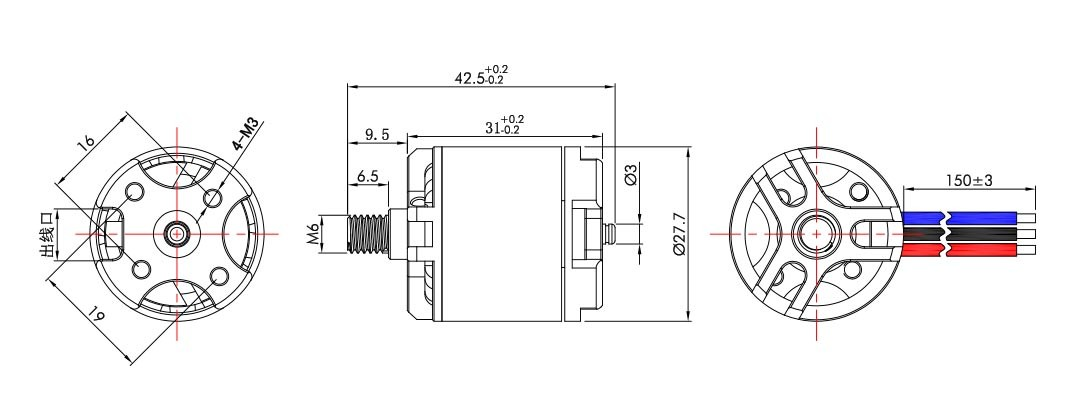
· Motor Model: AIR2216II KV920
· Motor KV: 920KV
· Motor Rated Voltage: 4S LiPo / 16V
· Motor Peak Current: 17A for 180 seconds
· Motor Maximum Power: 272W for 180 seconds
· Motor Weight: 64±2g including cable
· ESC Model: AIR 20A
· ESC Continuous Current: 20A
· ESC Peak Current: 30A for 10 seconds
· ESC Input: 3–4S
· ESC Throttle Signal Frequency: 50Hz–600Hz
· Propeller Model: T1045
· Propeller Size: 10 × 4.5 inches / 254 × 114.3mm
· Propeller Material: Nylon + glass fiber
· Propeller Weight: 13g per propeller
· Propeller Optimum RPM: 6000–7000 RPM/min
· Reference Test Condition: 16V, 80°C motor surface temperature at 100% throttle for 10 minutes
· Reference Test Result: 1332g thrust, 16.37A current, 260W power and 9857 RPM at 100% throttle
Want to Choose the Right Products for You?
Take a quick test to find the right propeller for you.
Matched Motor, ESC and Propeller Configuration
· AIR2216II KV920 motor for 4S LiPo / 16V systems
· AIR 20A ESC with 3–4S input support
· AIR 20A ESC: 20A continuous current and 30A peak current for 10 seconds
· T1045 propeller: 10 × 4.5 inches
· Nylon and glass-fiber propeller material
· Supplied test reference at 16V and 100% throttle: 1332g thrust and 260W power
Packaging & Shipping
· The combo is supplied as a coordinated multirotor propulsion package.
· Main components identified in the product materials: AIR2216II KV920 motors, AIR 20A ESCs and T1045 propellers.
· The product images show a dedicated AIR GEAR 450 packaging box and component storage layout.
· Please confirm the final component quantity, included accessories and package configuration before ordering.
· Package weight and shipping dimensions are not specified in the supplied product materials.
Need a Custom
Share your UAV requirements. We’ll help evaluate the right propeller solution.
Configuration and Safety Notice
· Confirm that the aircraft battery and power distribution system are compatible with the AIR2216II KV920 motor rated voltage of 4S LiPo / 16V.
· The AIR 20A ESC is specified for 3–4S input; do not connect it to a battery outside the stated range.
· Match the motor rotation direction and propeller orientation before powering the propulsion system.
· Check the frame, propeller clearance, wiring, connectors and cooling conditions before the first test.
· The supplied thrust and power values are reference results from the provided test data under specific test conditions, not a universal flight-performance guarantee.
· The recommended aircraft configuration should be reviewed before use, especially for coaxial or different multirotor layouts.


